Warittha 'Rung' Panasawatwong defends her Ph.D.
(2026-05-01) -- written by webmaster
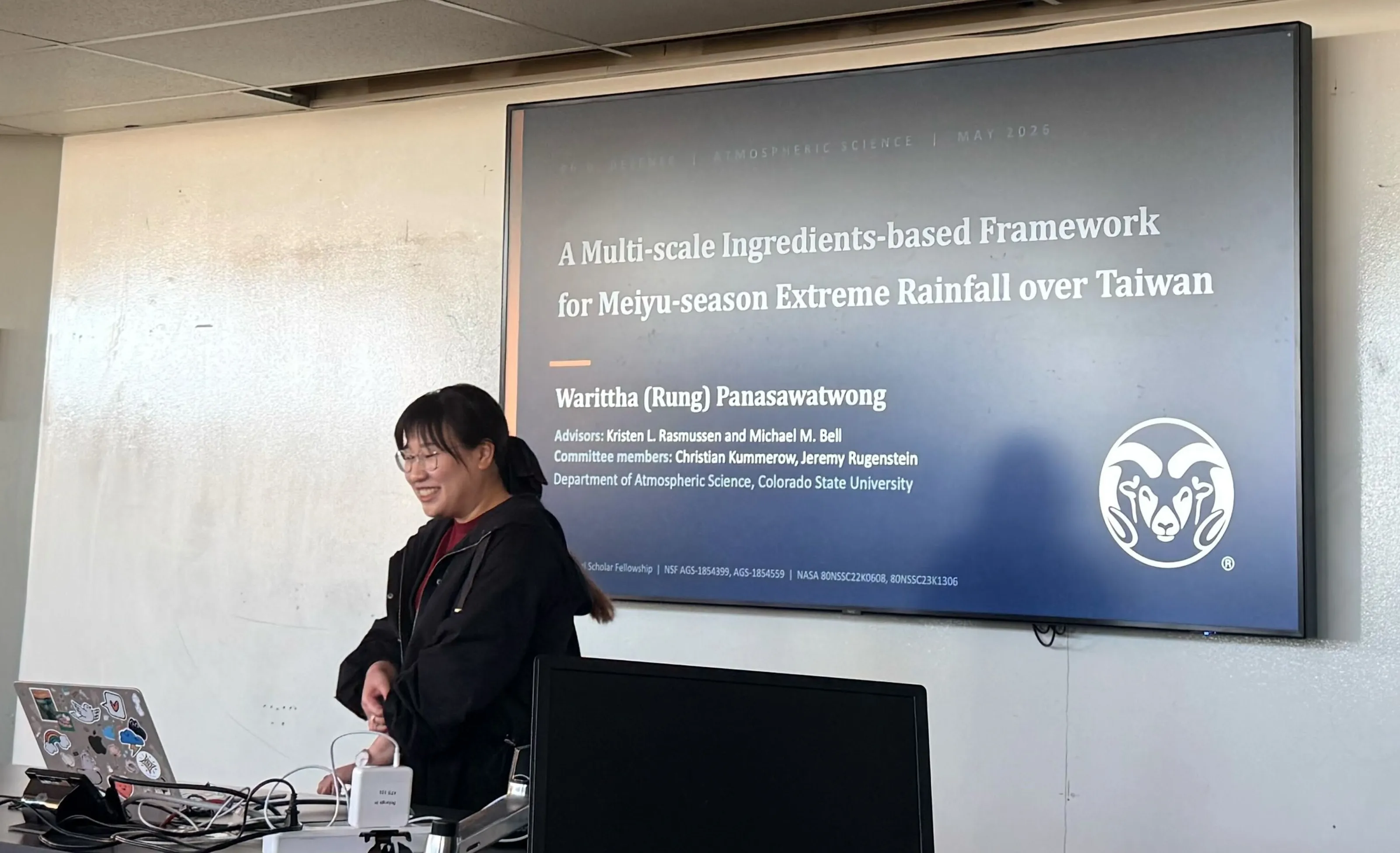
Congratulations to Rung Panasawatwong who successfully defended her Ph.D. entitled, “A Multi-Scale Ingredients-Based Framework for Meiyu-Season Extreme Rainfall over Taiwan” on May 1st!!
Rung was able to travel back to Fort Collins to defend her PhD, and was welcomed back with excitement by both the Bell and Rasmussen research groups.
Abstract
Heavy rainfall during the Meiyu season is among the most high-impact weather hazards affecting East Asia, producing flash and river flooding and widespread impacts from late spring through early summer. Over Taiwan, the interaction of the Meiyu front with the steep topography of the Central Mountain Range (CMR) amplifies rainfall totals and challenges both operational forecasting and physical understanding. This dissertation develops a framework for diagnosing Meiyu-season extreme rainfall by applying a common set of storm-mode and ingredients-based diagnostics across satellite climatology, numerical modeling experiments, and convection-permitting ensemble contexts.
The first study (Chapter 2) develops a 15-year climatology of extreme convective storm modes over tropical and subtropical East Asia using the Tropical Rainfall Measuring Mission (TRMM) Precipitation Radar. Deep and Wide Convective Cores (DWCCs) and Broad Stratiform Regions (BSRs) dominate volumetric rainfall in the moisture-rich Meiyu environment, despite the higher instantaneous rain rates of the smaller Deep Convective Cores. The analysis shows that the broader systems are associated with larger in area and longer timescales of vertical moisture flux and low-level wind shear that support the development of the horizontally large, organized storms. DWCCs and BSRs are also associated with the strongest large-scale moisture convergence along the Meiyu frontal band.
The second study (Chapter 3) examines the 1–3 June 2017 extreme Meiyu rainfall event over Taiwan using a convection-permitting Weather Research and Forecasting (WRF) simulation, with a halved-terrain experiment to isolate the role of the CMR. Reducing the CMR height by 50% shifts DWCCs from over the mountains to locations offshore east of Taiwan, allows BSRs to expand westward over the island displacing the DWCC-dominant regime, and reduces total rainfall over Taiwan by approximately 30%. Upward vertical velocity and vertically integrated moisture flux emerge as the key variables through which terrain modulates the storm-mode balance and the associated rainfall, with further modulations by changes in the low-level shear on the leeside of the CMR.
The third study (Chapter 4) extends the framework to ensemble forecasting through the analysis of a 20-member subset of the Penn State University Ensemble Kalman Filter WRF ensemble (PRECIP PSU-EnKF) of Intensive Observation Period 1 of the 2022 Prediction of Rainfall Extremes Campaign in the Pacific (PRECIP). The top quintile of members produces 1.6–1.9 times as much 48-hour total rainfall as the bottom quintile. Domain-integrated upward vertical velocity and upward moisture flux are strongly correlated with total rainfall. Domain mean total precipitable water (TPW) has low correlation with total rainfall, but TPW does show slight increases for all storm modes in the high-rainfall members. r. High-rainfall members produce more extensive BSR coverage along the Meiyu front and show elevated DWCC frequencies over western Taiwan and surrounding ocean regions, while low-rainfall members show lower DWCC and BSR frequencies. The ingredient separation between high- and low-rainfall members is established at the first model output time, suggesting that the rainfall spread originates from initial-condition differences rather than from evolution during the simulation.
The three studies in this dissertation consistently identify the same dominant storm modes and the same controlling atmospheric ingredients for Meiyu-season extreme rainfall over Taiwan. DWCCs and BSRs produce the majority of the rainfall across all three datasets, with large-scale upward moisture flux and low-level shear emerging as the key environmental ingredients. The variability in these DWCCs and BSRs is strongly influenced by the Taiwan CMR and the synoptic dynamical forcing, with less influence from variability in the available moisture. These results advance the process-based understanding of extreme rainfall in moisture-rich environments.